
From the Gulf countries to Malaysia and the UK to the US, the multi-agency operation christened 'Vande Bharat Mission' will see the state-owned AI operate 64 flights till May 13 in the first phase to ferry around 15,000 Indian nationals from 12 countries.

Virat Kohli is the "benchmark" and that is why all West Indies players should work as hard as the Indian captain to achieve their goals, believes their assistant coach Roddy Estwick.

Manchester United have deposed Real Madrid as the world's richest soccer club after revenue grew to a record $735 million in 2015-16, according to Deloitte's annual Money League published on Thursday.

The flight will operate every Tuesday, Thursday and Sunday. While the inaugural flight AI 139 left at 6 pm (Indian time) on Thursday, the scheduled departure will be 4.50 pm (Indian time) from March 25 when the summer schedule comes into operation.

As the pandemic unfolded, the India-China relationship has come under severe stress. To restore normalcy, agreements between the two countries must be respected scrupulously in their entirety. Where the Line of Actual Control is concerned, any attempt to unilaterally change the status quo is unacceptable, declares External Affairs Minister Dr Subrahmanyam Jaishankar.

India has got cracking into setting up its eyes and ears in the Indian Ocean

India's still male-dominated corporate environment wittingly and unwittingly contrives to put women employees on the back foot.

Midfield lynchpin Suresh Singh feels India would need to improve their final pass, but an improvement in department would not be enough against Colombia's all-round superiority.

News of all that's transpired on and off the football field

The best in international photojournalism was recently announced by World Press Photo's Annual Photo Contest. Despite fierce competition, the jury was forced to select just a handful of images from more than 73,044 photos by 4,548 photographers across 125 different countries. This year's grand prize was awarded to Venezuelan photographer Ronaldo Schemidt, earning him the title of Press Photographer of the Year. Here are some of the winners.

News of all that's transpired on and off the football field

'India in 2020 is a lot better prepared than in 1962.' 'It is no longer a pushover; and anything other than a crushing Chinese military victory will be a major loss of face for China,' observes Rajeev Srinivasan in the first of a three part column.

The government's leaks to the media and General Singh's very vocal comments on the charges against him have played right into the hands of separatists and their cross-border sponsors, says Nitin Pai

The agreement was reached in intensive negotiations between contact groups that Obama and Modi had set up in September.

Talmiz Ahmad is a former Indian ambassador to Saudi Arabia, Oman and the UAE. In an interview with Aditi Phadnis, he says the disequilibrium in Iraq will continue to prevail. Ahmad also says there are indications that the US is now anxious to avoid intervening militarily in West Asia, and that this is the appropriate moment for Asia to assume responsibility for its own security. Edited excerpts:
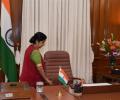
Sushma Swaraj, like Clinton, has a strong political base in her own party and is likely to have her imprint on foreign policy, says Ambassador T P Sreenivasan.

Indians in countries like the United States, China, Australia, Japan, Singapore, Egypt, Israel and South Africa celebrated the day with hoisting of the national flag and singing of patriotic songs.

The UAE has played 21 ODIs in 20 years. The Indians have played 22 ODIs in 12 months. Prem Panicker surveys the landscape of the mismatched 'contest' at the WACA.

'It is vital we should form an international coalition against ISIS, because their brutality and the use of the Internet for jihadist activities is a reminder that the entire world community has to be in this together,' US Congressman Ed Royce, chairman of the House Foreign Affairs Committee, tells Aziz Haniffa/Rediff.com in an exclusive interview ahead of Prime Minister Modi's visit.

'It was China's rise that caused the New Cold War in Asia as it prompted the United States to rebalance its forces in Asia to experiment with engagement and containment at the same time,' says T P Sreenivasan.

New Delhi and Beijing are the only two regional capitals that have commented on US President Donald Trump's speech on August 21 outlining the way forward in Afghanistan. The Indian foreign ministry statement was effusive in praise, while the Chinese statement has been one of cautious and guarded hope. Delhi has identified itself with Trump's Afghan strategy, whereas the Chinese stance is calibrated -- observant and objective, keeping a distance, says Ambassador M K Bhadrakumar.

'The Modi government's lurch toward America has not brought it any dividends so far. The Western world is simply not in a position to make big investments in India... India needs to take a leap of faith vis-a-vis China.'

In perhaps the first major conference on the United States-India strategic partnership in the aftermath of the Khobragade controversy that plunged the bilateral relationship in a downward spiral and is now in the process of being resurrected, the undeniable consensus among the panelists and participants was that much ballyhooed strategic convergence between Washington and New Delhi has dissipated.

In his penultimate State of the Union address, Barack Obama said that the economy is improving.
 © 2026 Rediff.com - Advertise with us - Disclaimer - Privacy Policy - Sitemap - Feedback - About us - Terms of use - Grievances